Notebooks
Open interactive Python notebooks in a tab next to your chat, so you can explore and visualize data without leaving the conversation. A notebook is a shared document you and the agent build together: you edit and run cells directly, while the agent reads, writes, and runs cells alongside you as you talk through the analysis. Notebooks run on a dedicated notebook runtime.
Notebooks require a Kilo account. Sign in to create, open, and work with them.
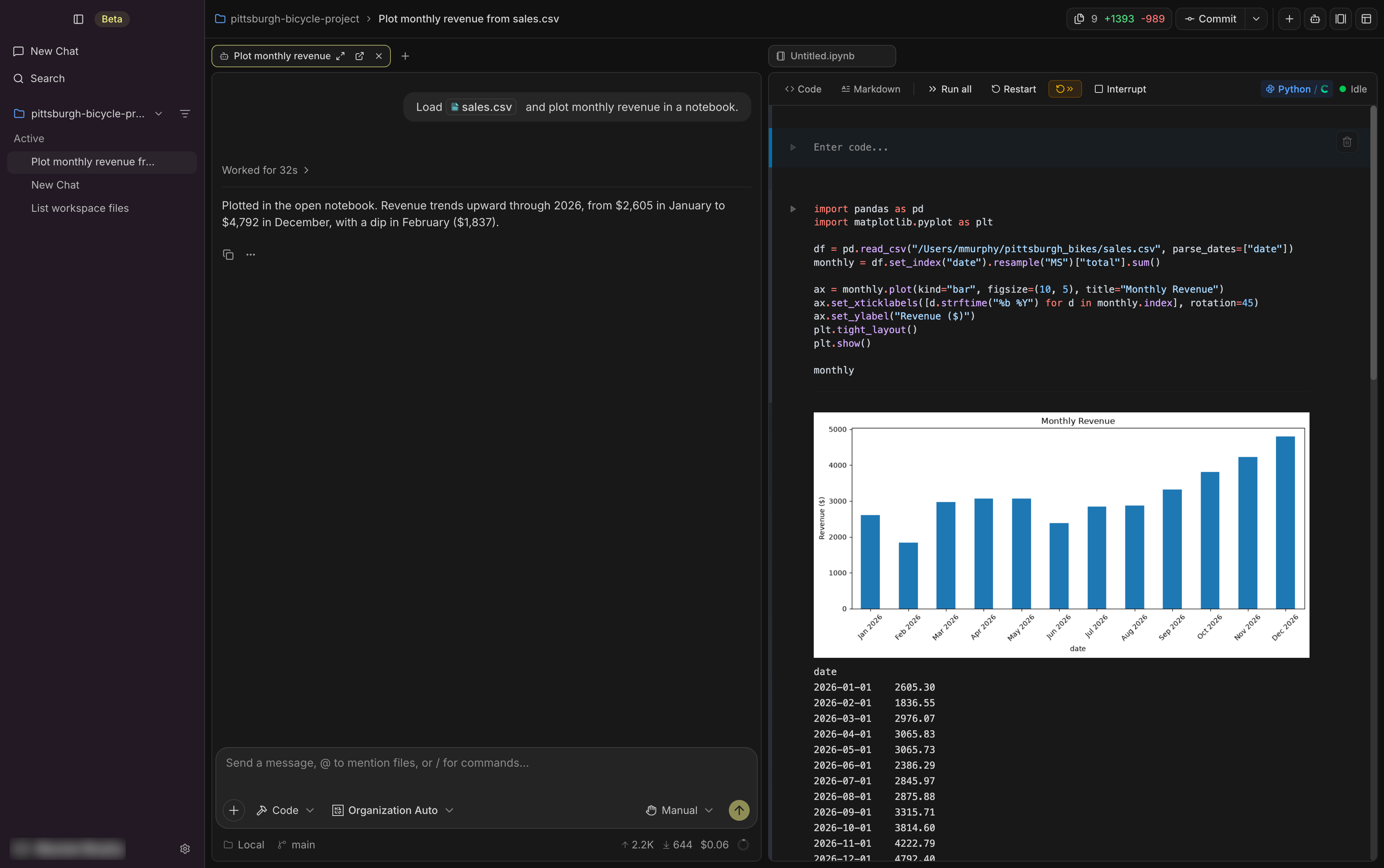
Open a notebook
A notebook opens as its own tab beside the chat. There are a few ways to get there:
- Ask the agent to list the files in your workspace, then select an
.ipynbfile in its reply to open it. - From the Files tab, search or browse the workspace and select an
.ipynbfile. - Ask the agent to open it by name — the agent can open and list notebooks for you, so the one you're discussing stays in view. You can also create a new notebook by asking the agent.
If you're signed out, the Notebook option in the + menu is grayed out, and a notebook you open from Files or a chat link shows a sign-in prompt instead. If you sign out while a notebook is open, the tab shows the sign-in prompt until you sign in again.
Work with cells
The toolbar at the top of the notebook has controls to add a code cell, add a Markdown cell, run cells, restart, restart and run all cells, and interrupt a running cell. Run a cell to see its output inline, and view the status (such as Idle) on the right of the toolbar.

Each individual cell includes controls to run it, switch it between code and Markdown, hide its input or output, and delete it.
Edit with the agent
Work on notebooks together with the agent. Ask it to make a change — fix a typo, add analysis, rework a chart — and it reads the notebook, edits or adds cells, and saves. When the notebook is open beside the chat, the results appear in its tab, and a dot marks each cell the agent changes so you can see at a glance what it edited. The notebook doesn't need to be open, though — the agent can edit any notebook in your workspace.
If you're signed out when the agent tries to open or list notebooks, the chat shows Sign in to use embedded notebooks? with Sign in and Not now. After you sign in, the agent continues the task. Not now turns off the agent's notebook tools until you sign in or restart the app. Other features still ask on their own.
Environment and packages
Each notebook uses a Python environment. Select the kernel button in the toolbar to see the details of that environment. New notebooks can get a shared environment.yml in their workspace; toggle this under Settings → Notebooks.
The agent can work with conda environments too — ask it to find an appropriate conda environment for this notebook and point the notebook at it, and it will. A helpful pattern is to have the agent write an environment.yml into the workspace: then every notebook there, existing or new, picks up that environment automatically.
Before the agent adds packages to a notebook that you haven't approved yet, it asks you first. It also flags package names that look like misspellings of popular packages (a common way to slip in malicious packages).
Runtime status
The notebook runtime starts on demand. While it's starting you'll see a brief status; if it can't be reached, the tab shows a Retry button.