What Do We Mean When We Say Sovereign AI?
A practical framework for separating data, infrastructure, model, and jurisdictional sovereignty instead of treating sovereignty as a binary label.
Read the articleRoute AI coding through EU providers and policies while keeping model freedom, BYOK setup, and enterprise controls your team needs.
EU inference
Open-weight and frontier models via EU inference providers
EU cloud compute
Contractually scoped EU infrastructure for Enterprise
Governance
Enterprise model & provider allowlists
BYOK
Regional endpoints from your vendors
Why EU-first matters
European AI adoption is moving from experimentation to governed rollout. Kilo helps teams standardize AI coding without giving up provider choice or regional strategy.
European teams increasingly need to document where source code, prompts, and AI inference requests are processed.
Avoid being locked into one cloud, one model vendor, or one regional strategy as AI regulations and provider options evolve.
Centralize approved model and provider decisions instead of relying on every developer to configure AI tools manually.
Start with requirements, not labels
Work through eight focused steps covering priorities, product surfaces, inference, compute, model access, and governance to get a tailored Kilo plan.
What Kilo supports today
Kilo gives Enterprise teams the controls to build an EU-first setup, while keeping the caveats visible for open-weight provider routes and frontier lab regional availability.
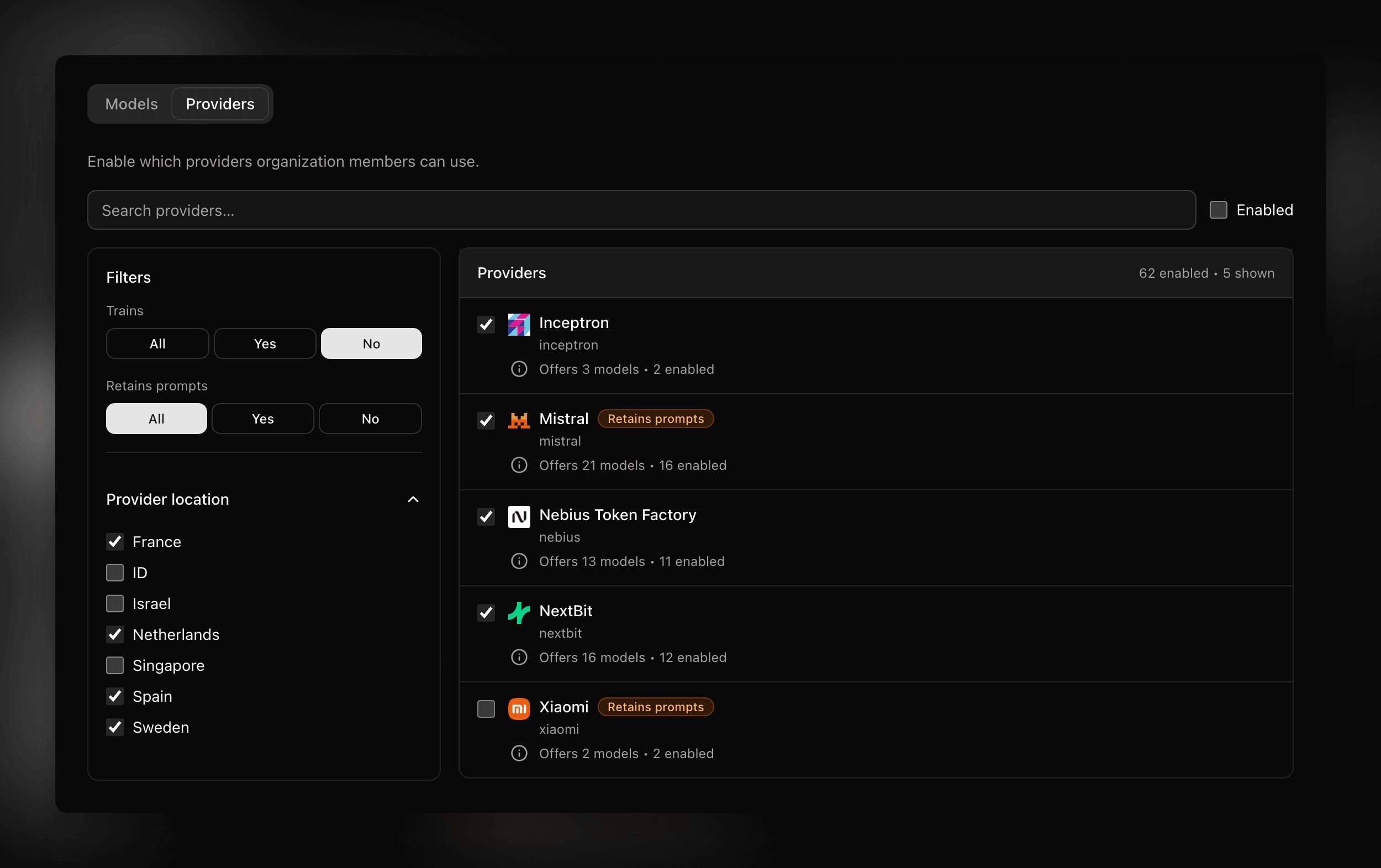
Provider controls
Enterprise provider configuration gives teams a concrete way to turn EU-first policy into day-to-day developer defaults. Admins can approve EU providers, restrict model access, and keep unsupported routes out of the engineering workflow.
Data & Privacy
We don't host models, we don't train on your code or prompts, and we don't retain them for our own purposes. Kilo routes inference requests to the providers you choose and your data stays governed by those provider agreements.
Kilo does not operate model compute or serve models. Kilo Gateway routes managed and BYOK requests to the provider you configure: EU-hosted, frontier lab, or another approved endpoint.
Kilo does not use your code or prompts to train models or retain them for its own purposes. Product terms and the selected provider's data handling policy still apply.
Review Kilo's security and privacy documentation, request your data, and learn exactly how we handle it at trust.kilo.ai.
European inference partner
Inceptron is one example of the EU provider strategy Kilo supports: European-hosted inference for open-weight models through Kilo Gateway and BYOK workflows. Teams can pair providers like Inceptron with other approved EU routes and frontier lab regional endpoints where available.
EU-first architecture
Start with approved providers, enforce those choices centrally, then apply the same policy across the Kilo surfaces your developers already use.
Step 1
Start with EU providers for open-weight models, EU-hosted frontier endpoints, and BYOK routes approved by your security and compliance teams.
Step 2
Use Enterprise provider and model restrictions so developers only see the options your organization has approved.
Step 3
Apply the same provider strategy across IDEs, CLI, Cloud Agents, Slack workflows, and Code Reviews.
Enterprise governance
Kilo for Enterprise gives platform, security, and engineering leaders the controls they need to adopt AI coding without letting every team pick its own unmanaged provider path.
Control who can access Kilo and apply the right permissions across your organization.
Keep teams inside approved provider routes without blocking the AI workflows they rely on.
Track adoption, spend, and model usage centrally instead of managing fragmented tool setups.
Use existing provider contracts and regional endpoint configurations where your vendors support them.
Apply EU-only model, provider, region, and inference rules to specific subsidiaries or business units from one central organization.
EU perspectives
Analysis for European technology leaders navigating AI sovereignty, model access, and emerging engineering obligations.
A practical framework for separating data, infrastructure, model, and jurisdictional sovereignty instead of treating sovereignty as a binary label.
Read the articleWhy model access, compute constraints, and open weights make provider independence an urgent issue for European AI teams.
Read the articleA practical translation of the Cyber Resilience Act into vulnerability handling, reporting, and record-keeping work.
Read the articleEU-first AI coding works best when provider controls are paired with model freedom, open-weight options, and enterprise governance.