
AI inference is getting cheaper per token. AI coding is still getting more expensive.
That is not a contradiction. Autocomplete used to make one small prediction at a time. An agent can inspect a repository, plan a change, edit several files, run tests, diagnose a failure, try again, and review its own work. One task can become dozens of model calls before a developer accepts the result.
The right target is therefore not the lowest token price. It is the lowest cost for a change that passes your tests and review.
Kilo publishes three views of that trade-off. KiloBench measures coding-task completion and cost through Kilo's agent harness. The usage leaderboard shows which models developers use in real workflows. The inference leaderboard compares traffic share, cost per request, cost per million tokens, cache ratio, and request success rate. They do not replace your own production data, but they make model quality and inference economics easier to evaluate than a price sheet alone.
Here is how engineering teams can turn those signals into a practical cost strategy.
The cost reckoning is here
On June 1, 2026, GitHub moved monthly Copilot plans to usage-based AI Credits. Completions remain unmetered, but agentic work now draws down a metered allowance—making sustained agent use visible as compute instead of hiding it inside a seat price.
But Copilot is not the cause. It is the signal.
TechCrunch reported, citing Bloomberg and The Information, that Uber consumed its annual AI budget in four months after encouraging broad adoption. It then introduced a monthly $1,500 cap per employee and per agentic coding tool, including Claude Code and Cursor, with exceptions available by permission.
Ramp's June 2026 AI Index shows how wide the spending range has become. Across more than 70,000 US businesses using Ramp, the top 1% by AI spend per employee averaged $7,449 per employee per month. The top 10% averaged $611; the median was $11.38. Ramp measures broad AI spending, not only coding agents, and it does not prove that higher spend creates higher productivity. It does show that a small group of intensive users can move far beyond ordinary seat-based budgets.
Falling token prices will not automatically solve this. If an agent uses more context, tool calls, retries, and parallel workers per task, the total bill can rise while every individual token becomes cheaper.
The answer is not to retreat to autocomplete. It is to measure accepted output, keep more than one model route available, and put limits around each route before usage expands.
Why do AI coding agents use so many tokens?
A coding agent is a loop, not a single response. A typical task can involve:
- Loading project instructions and tool definitions.
- Searching the repository and reading relevant files.
- Planning the implementation.
- Editing code and running commands or tests.
- Reading the output, diagnosing failures, and retrying.
- Reviewing the final diff against the original request.
Every step can generate another model request. Later requests may carry the system prompt, available tools, file contents, test logs, and much of the earlier conversation again. Subagents and parallel agents create additional request streams.
This is why a short prompt can lead to a large bill. The prompt is only the instruction; the agent's work happens after it.
The most useful metric is cost per accepted task: all agent spend for a task, including failed attempts and escalation, divided by the changes that meet an agreed quality bar. For a team, it is worth including human correction time too. A cheap attempt that needs thirty minutes of repair may be more expensive than a stronger model that succeeds on the first pass.
Keep the quality bar simple:
- The requested behavior is present.
- Tests and static checks pass.
- No unintended files changed.
- Review does not require substantial rework.
Then record the model, retries, inference cost, review time, and final outcome for representative tasks. That gives engineering leaders something more useful than a token total: evidence of what the team is paying to finish work.
Which coding tasks should use cheaper models?
Start with the least expensive route that reliably passes your quality bar, then escalate based on difficulty and the cost of failure.
| Task | Start with | Escalate when |
|---|---|---|
| Explanations, documentation, and formatting | Free or Efficient | The answer misses repository-specific context |
| Unit tests, summarization, and bounded refactors | Efficient | Tests repeatedly fail or behavior crosses system boundaries |
| Routine code review | Efficient | The change is security-sensitive or architecturally significant |
| Repository exploration | Efficient with focused retrieval | The task genuinely requires broad cross-system reasoning |
| Background automation | Free or Efficient | Reliability falls below the accepted threshold |
| Architecture, migrations, and security-sensitive work | Frontier or strong reasoning model | Start strong when a wrong decision has a high downstream cost |
| Subtle debugging and ambiguous failures | Frontier or strong reasoning model | Use focused logs and evidence to keep the investigation bounded |
The escalation rule matters more than the initial choice. Move to a stronger model after a defined quality check fails, not simply because the task feels important or a developer is accustomed to selecting the most expensive option.
A frontier model can also be cheaper in practice. If it avoids several failed attempts, an hour of review, or a production incident, its higher token price may produce a lower cost per accepted task. Conversely, an open-weight model is not automatically cheap: hosted rates, local hardware, latency, retries, and maintenance all belong in the calculation.
Consider a hypothetical routine refactor. An Efficient attempt costs $0.40 and passes the team's checks four times out of five. The failed attempt escalates to a Frontier route that costs $2.00 and produces an accepted change. Across five tasks, the routing policy spends $4.00, or $0.80 per accepted task. Sending all five directly to Frontier would cost $10.00. But if those Efficient attempts created significant review or repair work, the comparison could reverse. The team should keep the route only if accepted output, not just inference, is cheaper.
That is the policy to revisit as models and prices change: use efficient or open models for bounded, reversible work; use frontier reasoning when ambiguity or failure is expensive; and judge both against the same quality bar.
Smart model routing: do more, spend less
One of the most effective levers for reducing AI coding costs is matching the model to the task. Not every prompt deserves a frontier model.
Architecture decisions, security-sensitive changes, subtle debugging, and ambiguous multi-system work can justify the strongest available reasoning. Documentation, test generation, formatting, summarization, and bounded refactors often do not. Using a frontier model for every task is like flying business class for a short commute: possible, but structurally wasteful.
Manual selection works for an individual who knows every model and watches every request. It becomes inconsistent at team scale. Developers should not have to interrupt their work to compare benchmarks and provider prices before each prompt.
That is what Auto Model is built for. Kilo offers three strategies:
- Free routes to currently available free and experimental models.
- Efficient uses live session classification to optimize for economical task completion, delivering a capable, cost-effective paid route for day-to-day work.
- Frontier prioritizes maximum capability when the task needs it.
You can still choose a specific model, connect a supported provider by bringing your own key (BYOK), or use local models through Ollama or LM Studio. Auto Model is a default route, not a lock-in.
In the Efficient versus Frontier comparison published on June 26, 2026, Auto Efficient completed 46.7% of KiloBench task trials at an average cost of $0.22 per trial. The average across the published Claude Opus 4.8, Claude Sonnet 4.6, and GPT-5.5 results completed 65.6% at about $0.79 per trial. Auto Efficient therefore delivered 71% of the frontier average's completion rate at 72% lower average cost. Each published result covers 445 task trials: 89 Terminal Bench 2.0 tasks across five runs.
Published KiloBench comparison
72%
lower average cost per task trial
46.7%
Auto Efficient completion rate
$0.22
average cost per task trial
This is a Kilo-owned benchmark using Kilo's agent harness, not an independent study or a guarantee of customer savings. Results depend on the task suite, models, harness, and evaluation date.
The bigger advantage is freedom to change the route. Kilo Gateway offers 500+ hosted models, while Kilo also supports BYOK and local models. When quality, price, availability, or policy changes, the team can change the model without replacing its coding workflow.
The plan/build/review loop
One of the largest hidden drivers of AI coding cost is poorly scoped work.
When the objective is vague, acceptance criteria are missing, or too much context is attached, the agent explores. It reads files it does not need, writes code that gets discarded, and carries a growing conversation into every correction. Each round trip costs tokens and developer attention.
A deliberate workflow interrupts that waste:
- Plan first. Use Kilo's Plan agent for source investigation, dependencies, risks, acceptance criteria, and verification steps before implementation begins.
- Build against the plan. Use Code to make the bounded change with the least expensive model that reliably handles that class of work.
- Review before pushing. Compare the diff and checks with the original request using
/local-review-uncommittedor/local-review, or run hosted Kilo Code Reviews on the pull request. - Escalate deliberately. Move unresolved failures or high-risk decisions to a stronger model instead of allowing an open-ended retry loop.
A few context habits make the same workflow cheaper:
- Attach specific files instead of whole folders when the relevant scope is known.
- Start a new session when the subject changes; use
/compactwhen a long-running task needs continuity. - Trim noisy command output and keep generated directories out of context.
- Cap steps and retries, and keep doom-loop protection enabled for unattended work.
Planning every trivial edit would add unnecessary overhead. The loop earns its keep when the task is ambiguous, spans several files, or would be expensive to get wrong. In those cases, the cheapest correction is often the one made before implementation starts.
Kilo Pass, Gateway, BYOK, or local models?
Model choice is only half of cost control. Teams also need to decide who supplies the inference and how it is paid for.
| Route | Best fit | Main advantage | Main trade-off |
|---|---|---|---|
| Kilo Gateway | Variable usage and broad hosted-model access | Upstream provider pricing passed through without a general Kilo token markup | Spend varies with agent activity |
| Kilo Pass | Recurring Kilo credit usage | Paid credits plus unlockable monthly bonus credits | Bonuses require qualifying usage and expire each cycle |
| BYOK | Existing provider credits, coding plans, or enterprise agreements | Keep provider billing and negotiated terms | Keys, policies, rate limits, and invoices remain distributed |
| Local models | Privacy-sensitive or high-volume bounded work | No hosted token charge | Hardware, operations, latency, and retries still cost money |
Kilo Gateway has no monthly platform fee for individual pay-as-you-go use. Credits work across Kilo products and the hosted model catalog, so developers can change the model mix without changing tools.
Kilo Pass is for recurring Kilo usage. It starts at $19 per month: the subscription amount is added to the Kilo balance as paid credits, and qualifying usage can unlock free bonus credits on top. Monthly loyalty rewards can reach 40%; annual plans currently provide a 50% monthly bonus. Bonus credits expire at the end of the cycle, so Kilo Pass is not unlimited usage. It works best when normal monthly usage is high enough to unlock and use the bonus.
BYOK keeps supported provider billing under your control. A developer or organization can connect an eligible provider account and keep using Kilo workflows such as Cloud Agents and Code Reviews while the upstream provider applies its own API pricing, credits, coding plan, or negotiated agreement.
Local models avoid hosted token charges but are not free. Hardware, electricity, setup, maintenance, latency, and additional retries all count. They can still be the right route for privacy-sensitive work, predictable high-volume tasks, or environments where code cannot leave controlled infrastructure.
These routes are not mutually exclusive. A team might use Kilo Pass or Gateway for flexible model routing, BYOK for an existing provider contract, and local inference for selected repositories. Kilo's role is to keep those choices inside one agent workflow rather than forcing the company to standardize on one model and one bill.
How should engineering teams control AI coding budgets?
Model freedom is not a free-for-all. Engineering leaders need approved routes, visible usage, and a way to stop outliers before they consume the shared budget.
A practical operating model has four steps:
- Baseline representative work. Measure accepted-task cost for debugging, tests, refactors, documentation, and feature work. Track median and 90th-percentile (p90) results so a few runaway sessions do not disappear inside an average.
- Pilot an escalation policy. Route bounded work efficiently, start high-risk work on a stronger model, and define the quality check that triggers escalation.
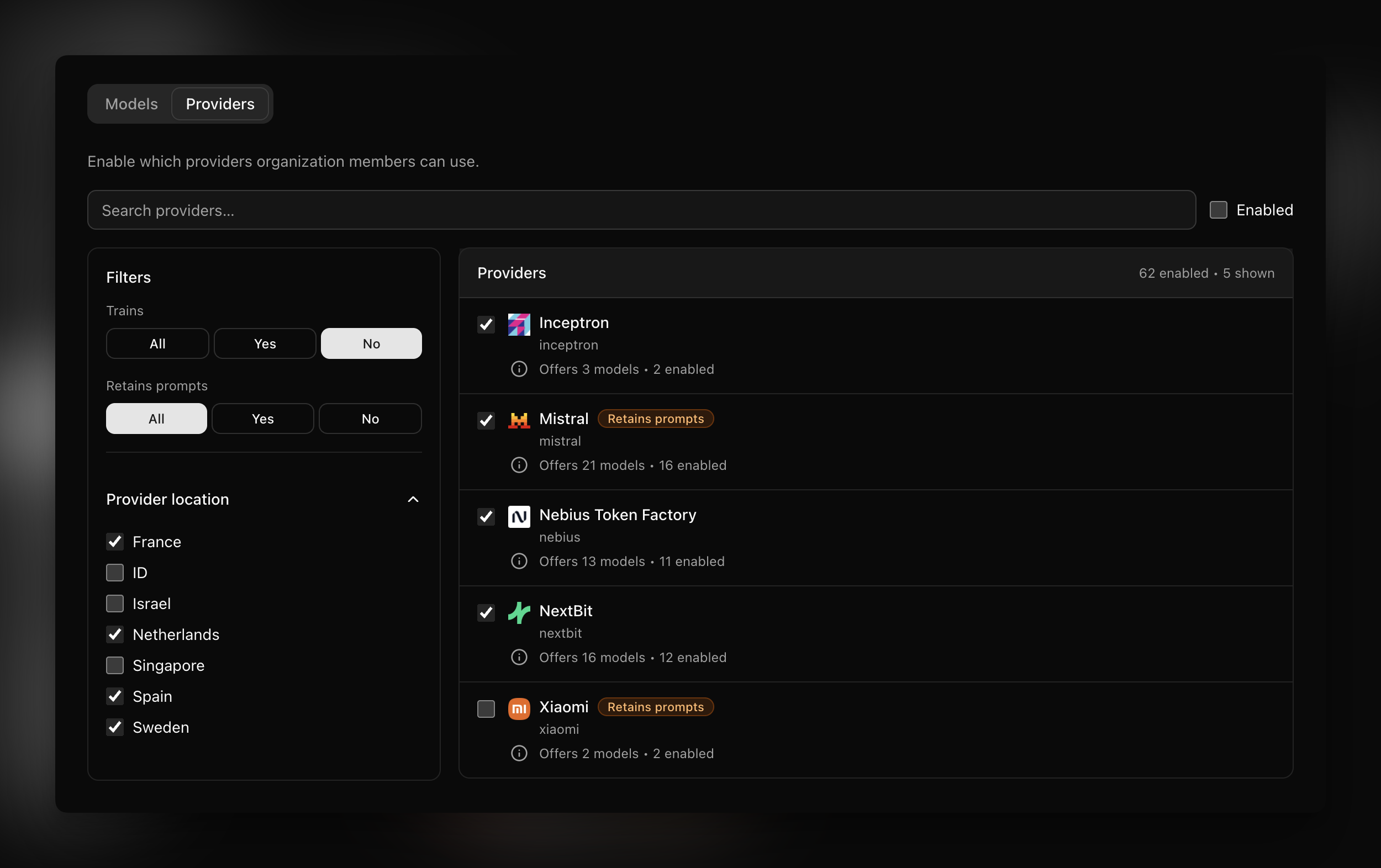
- Add guardrails. Set balance alerts, administrative roles, and model or provider policies based on cost, prompt training, retention, and location.
- Review cost and quality together. Look at spend by model, project, task type, and active developer alongside retry rate, accepted output, and human correction time.
For traffic routed through Kilo Gateway, Kilo gives teams request-level visibility into model, provider, input and output tokens, cache activity, cost, and BYOK status. Organization dashboards make it possible to see which developers, projects, and models drive usage before finance receives a surprise invoice.
Enterprise owners can block models or entire providers for organization members. Provider metadata can also help teams evaluate whether a route trains on prompts, retains prompts, or operates in an approved location. Gateway policies separately support model and provider allowlists. Identity, audit, and administration controls sit around those cost policies so they can be applied consistently.
The five numbers worth reviewing regularly are:
- Cost per accepted task
- Median and p90 task cost
- Retry and escalation rate
- Spend by model, task type, project, and active developer
- Human review and correction time
The Uber example shows why this matters: adoption can run ahead of the controls. A daily cap is useful, but the better outcome is knowing which work produces value before the organization reaches the cap.
The result
The teams that come out ahead on AI coding cost are not the ones that restrict AI until developers stop using it. They build a clear answer to three questions:
- Which model is right for this task?
- Which payment and provider routes are approved and visible?
- Is the work scoped and reviewed before more compute is spent?
Kilo is the model-independent control layer for that workflow: measure useful output, route work by difficulty, choose how inference is paid for, and govern usage centrally without locking every developer into one model, provider, or interface.
That gives developers freedom where it improves the work, and gives engineering and finance the controls they need before agent usage scales.
Control cost without giving up capability
Route each task to the lowest-cost model that meets your quality and policy bar, and manage every route in one place.