Code Review
Every piece of code produced by Gas Town agents goes through automated review before merging. The refinery agent is dedicated to critiquing, verifying, and gatekeeping what lands in your codebase.
The Review Pipeline
When a polecat finishes a bead and pushes its branch, the work enters the review pipeline:
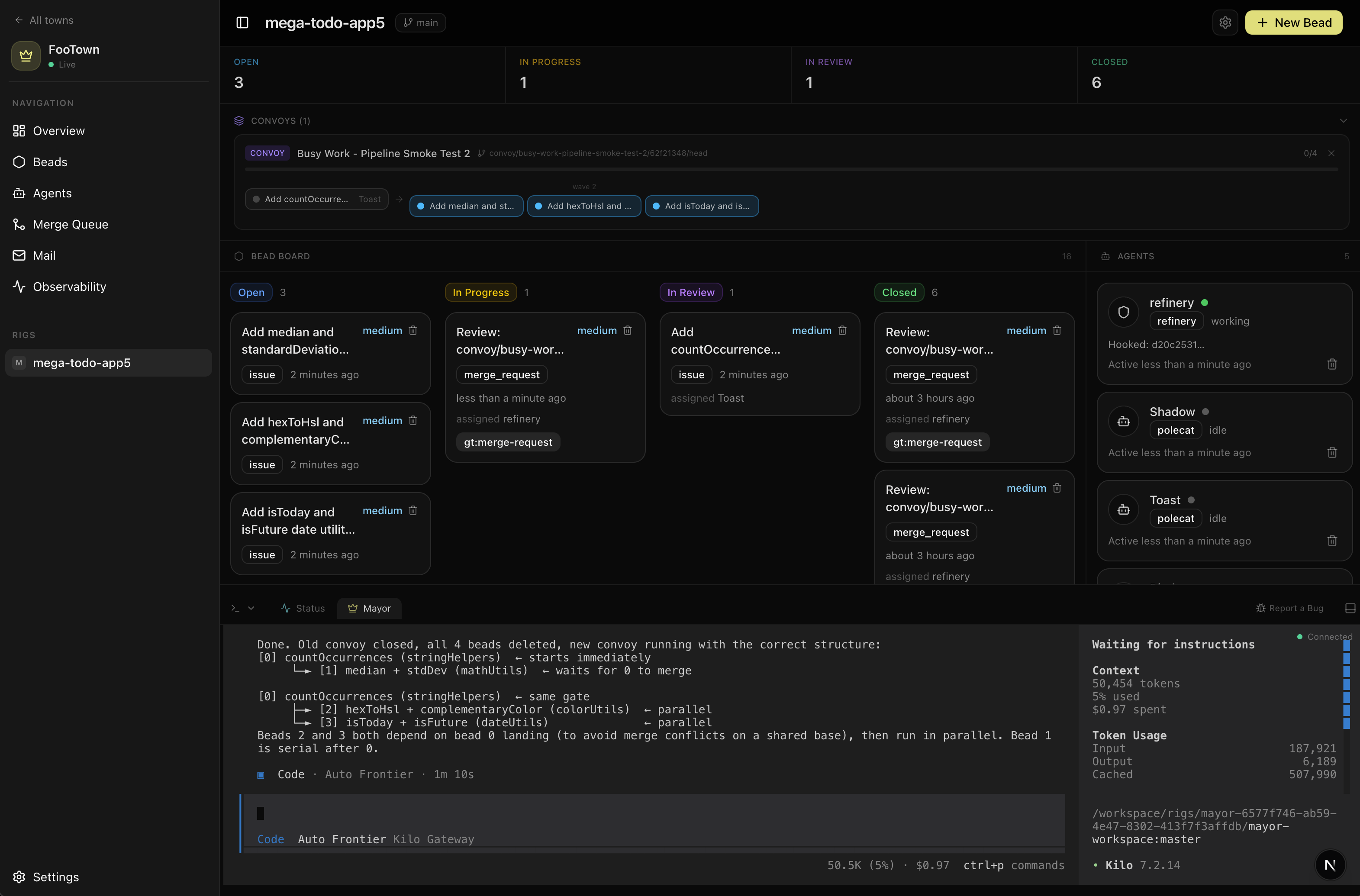
The refinery evaluates:
- Correctness — does the code do what the task asked?
- Style — does it follow project conventions?
- Completeness — are tests included? Are edge cases handled?
- Safety — any security issues, data leaks, or breaking changes?
Micro-Adversarial Loops
The core insight behind Gas Town's review system is adversarial iteration. Rather than one agent producing a final answer, two agents with different objectives improve the output through tension:
This pattern is fundamentally different from having a single agent self-review:
- Self-review has a confirmation bias — the same "mind" that wrote the code evaluates it
- Adversarial review creates genuine tension — the refinery has different priorities than the polecat
- Each revision cycle measurably improves the output because feedback is specific and actionable
The Loop in Practice
A typical bead goes through 1-2 revision cycles:
| Cycle | What happens |
|---|---|
| Write | Polecat reads the task, writes code, runs tests, pushes |
| Review 1 | Refinery finds 2 issues: missing test case, inconsistent naming |
| Revise 1 | Polecat adds the test, fixes naming, pushes again |
| Review 2 | Refinery approves — code meets quality bar |
| Merge | Code lands on target branch |
After 3 failed revision cycles, the bead escalates rather than looping forever.
Merge Strategies
Gas Town supports two merge strategies, configurable per-town or per-rig:
Direct Merge
The refinery merges directly to the target branch (convoy feature branch or main) without creating a GitHub PR. This is faster but gives you less visibility into individual merges.
Best for: trusted agent output, internal projects, rapid iteration.
Pull Request Mode
The refinery creates a GitHub PR for each merge. The PR includes:
- The diff
- Review comments from the refinery
- Status checks from CI
You can configure whether PRs auto-merge after refinery approval or require human approval.
Best for: production codebases, team environments, audit trails.
Convoy-Level Review
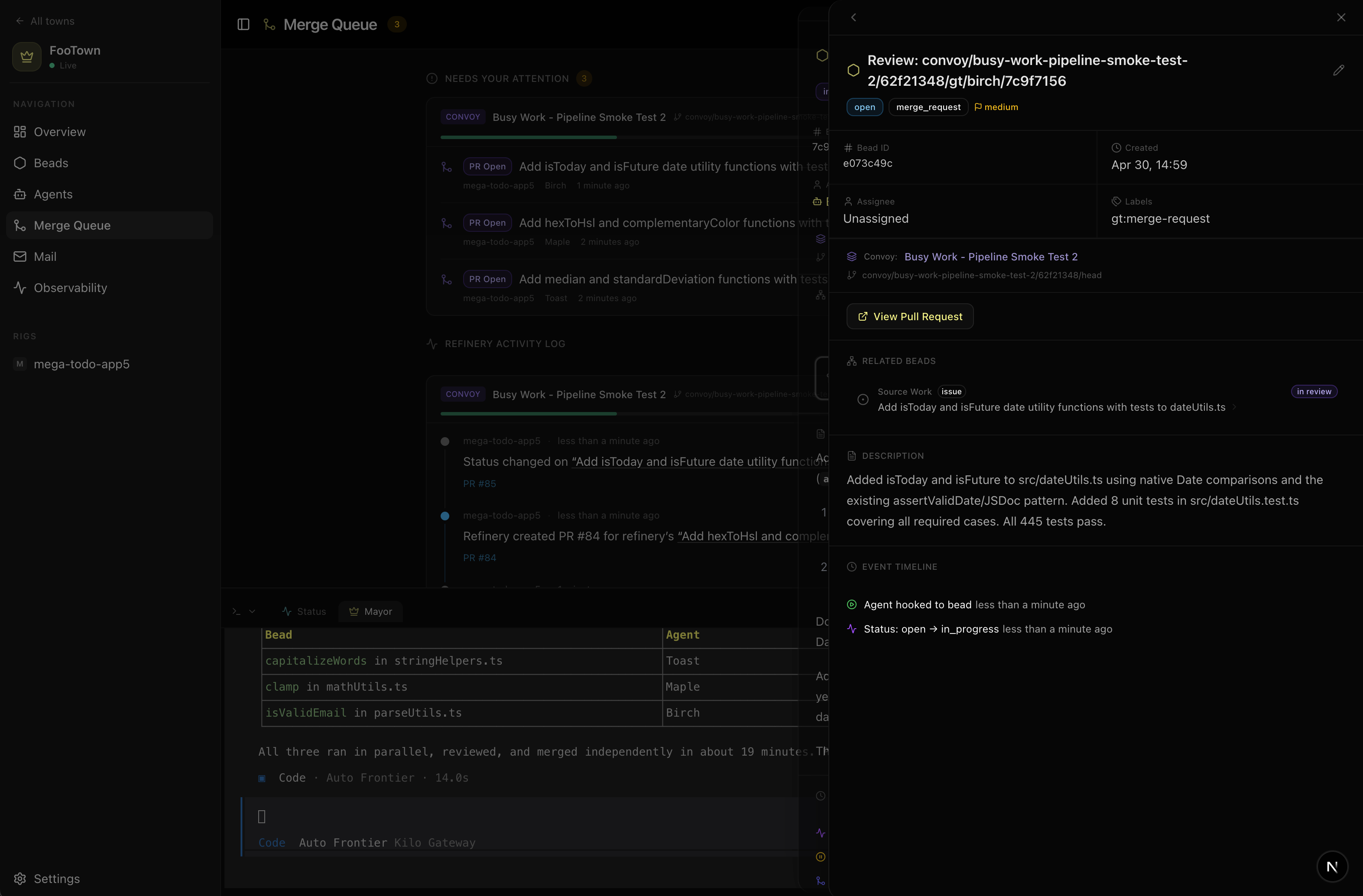
Convoys add an additional review layer beyond per-bead review:
| Review Layer | What's checked | Who reviews |
|---|---|---|
| Per-bead | Individual contribution quality | Refinery agent |
| Landing | Combined feature coherence | Refinery agent |
| Human (optional) | Business logic, architecture | Your team |
Combining with Kilo Code Review
Gas Town's refinery works independently, but combining it with Kilo Code Review creates an even stronger pipeline:
- Agent writes → agent-level refinery reviews (fast, automated)
- Code lands as PR → Kilo Code Review provides human-readable review (deeper, contextual)
- Human approves → code ships
This gives you automated adversarial review for speed plus AI-assisted human review for judgment — the best of both approaches.
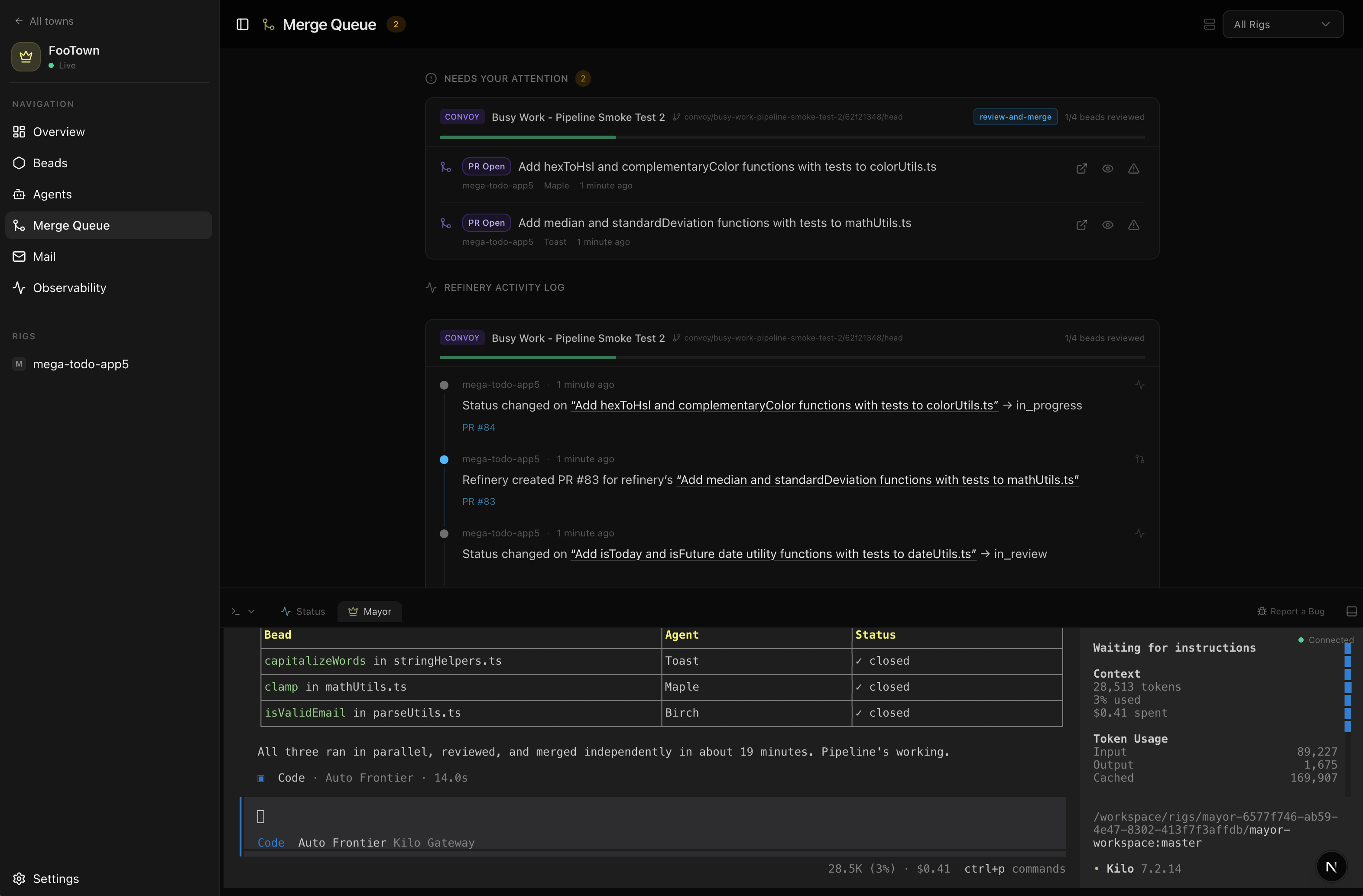
The Merge Queue
The merge queue page shows all active and completed reviews in your town:
Review Configuration
Customize the refinery's behavior in Town Settings → Review:
| Setting | Options | Default |
|---|---|---|
review_mode | always / never / pr_only | always |
merge_strategy | direct / pr | direct |
auto_merge | true / false | true |
review_gates | Strictness level (1-5) | 3 |
max_review_cycles | How many revision attempts | 3 |
Review Mode
always— every bead goes through refinery review (recommended)never— skip review, merge directly on polecat completion (fast but risky)pr_only— only review work that creates a PR
Review Gates
Higher gate levels make the refinery stricter:
- Level 1 — basic sanity (compiles, doesn't break tests)
- Level 3 — standard (style, tests, correctness) — default
- Level 5 — strict (architecture review, performance, security)
Handling Review Feedback
When the refinery rejects a submission, it provides specific, actionable feedback. The polecat receives this feedback and revises accordingly. You can see the feedback exchange in the bead's event history.
If a bead fails review 3 times, it transitions to failed and creates an escalation for human attention. This prevents infinite loops while ensuring difficult code doesn't slip through without proper quality.